

Julio Rodríguez, Version 3.0: The Evolution of a Superstar Archetype
Julio is morphing into something even rarer than fans think

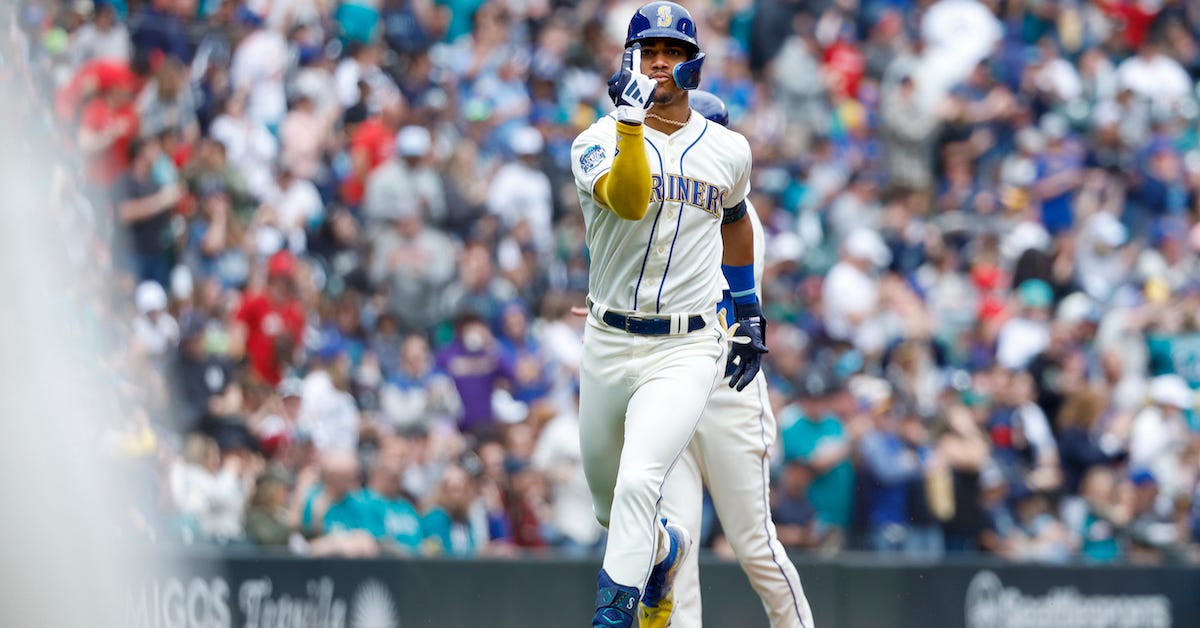
At a distance, Julio Rodríguez’s 2025 looks like a very good season that fell short of the “generational cheat code” hype: 710 plate appearances, a .267/.324/.474 line, 32 homers, 30 steals, 106 runs, and an OPS just under .800. For a lot of fans, that reads as plateau, not ascension. But once you get under the hood of his plate discipline, contact quality, and value metrics, the story flips completely. “Julio 3.0” isn’t a stalled superstar; he’s a more efficient, more stable, and more bankable version of the player who broke the league in 2022.
The short version: he’s striking out less, doing the same elite damage on contact, and turning into the kind of hitter who beats you with process, not just chaos. When that’s your baseline at 24, the rest of the AL West has a long-term problem.
From 1.0 to 3.0: Putting Numbers to the “Versions”
To get past pure narrative, you have to define Julio’s “versions” with actual traits. Early-career Julio (call it Version 1.0) was a controlled explosion. He ran a strikeout rate in the mid-20s, chased more than you’d like, but sat in the top 25 in baseball in average exit velocity — around 92.0 mph in 2022 and just over 92.5 mph in 2023. In-zone contact hovered near 80%, which meant that when he did connect, it was a nightmare, but there were enough whiffs in the zone to fuel slumps and game-to-game volatility.
Version 2.0, roughly late 2023 into 2024, was the streak-addict phase. The power stayed, with average exit velocity still around 91–92 mph and hard-hit rates among the league’s best, but in-zone contact actually dropped from over 83% in 2023 to under 79% in 2024. Same thunder, slightly less ability to get the bat on hittable pitches. You got those cartoon hot streaks where his rolling wRC+ would skyrocket, and then stretches where he looked like he was trying to hit a six-run homer every at-bat.
Version 3.0, the 2025 model, is where the math changes. The raw thump is still there — a 91.8 mph average exit velocity (33rd in MLB), a 48% hard-hit rate, and a near-10% barrel rate. But now, the in-zone contact rate bounces back toward the 80–81% range, and his overall strikeout rate finally dips into the low-20s, around 20.3%, sliding below league average for the first time in his career. This is the version where he stops paying a tax in the zone just to get to his power.
The contact quality table is the giveaway: same 90th-percentile EV, tighter plate discipline.


Plate Discipline: Fewer Wasted Swings, Same Fear Factor
The biggest upgrade in 3.0 is that Julio’s swing decisions stopped beating him as often. That mid-20s strikeout rate from his first couple of years has long been the only real blemish on his offensive profile. By 2025, he’s shaved roughly 4–5 percentage points off that number, moving from “acceptable for a power hitter” into “legitimately better than league average” in K%.
Underneath that is a cleaner in-zone contact picture. Where 2024 saw a dip below 80% in-zone contact — unusually low for someone in his tier — the 2025 data shows that metric climbing back up while his zone swing-and-miss rate ticks down. He’s not suddenly a slap hitter; he’s just missing fewer good pitches to hit. Out of the zone, the changes are smaller but meaningful: out-of-zone contact nudges up, out-of-zone whiff dips slightly, and more of those “panic” chases turn into survival fouls instead of free strikeouts.
Taken together, that’s a hitter who is still hunting damage but no longer sacrificing this many at-bats on pitches he can’t do anything with. Version 1.0 swung like every pitch might be his last. Version 3.0 is comfortable taking the borderline slider and trusting he’ll get something he can punish later in the count.
Contact Quality: The Hammer Didn’t Go Anywhere
If the plate discipline improvements came with softer contact, this would be a different conversation. They didn’t.
In 2025, Julio’s average exit velocity sat at 91.8 mph, placing him firmly inside the top 35 hitters in the sport, with a max EV north of 115 mph that lines up with the game’s true top-end thumpers. His hard-hit rate checked in at 48%, again in that upper tier where nearly half of his batted balls leave the bat at 95 mph or harder. A barrel rate around 9.8% is comfortably above league average, especially when you remember he’s not a one-dimensional DH — he’s doing this while handling center field and running the bases like a plus athlete.
The expected stats tell you the results undersold the process. In 2025, his wOBA sat around .341 while his xwOBA was roughly .348, suggesting the quality of contact he produced should have cashed out a bit better than it did in the box score. Spread over 650+ at-bats, that gap is the difference between people calling it a “nice” year and people dusting off the MVP talking points again. The contact didn’t get worse; the translation to outcomes just didn’t spike.
And he’s still an all-fields power/speed threat. Even with usage and wear, his sprint speed in 2025 sat around 29.2 ft/s, keeping him in the top-40 range in MLB, which paired with another 30-steal season keeps his overall impact profile closer to the Acuña/A-Rod-lite axis than to a prototypical corner-only slugger.
Value: The Floor Is Rising, Not the Ceiling Falling
All of this filters into the big-picture value metrics in exactly the way you’d expect for a superstar tightening up the edges of his game. He played 160 games in 2025 — 159 of them in center field — which is its own kind of superpower in a league where “load management” is practically a job description. FanGraphs has him living in that 5–6 WAR band again, right in line with, and in some ways ahead of, his Rookie of the Year breakout in total value.
The bat alone grades out in that middle-of-the-order anchor range: wRC+ in the mid-to-high 120s, essentially three years running, which is what you get when a guy’s worst full season is still 25–30% better than league average at creating runs. Add plus baserunning and at least above-average defense in center, and you’ve got a profile that sits on the MVP ballot every year almost by default, even if the OPS doesn’t start with a 9.
Zooming out, his career line through age 24 — about 2,600 plate appearances of .274/.331/.469 with 112 homers, 116 steals, and an .800 OPS — is exactly the kind of “boring” greatness you only appreciate if you know how rare it is. On a per-162 basis, you’re talking 25–30 homers and 25–30 steals with plus defense in center. There are not many center fielders in history sitting on that kind of production through age-24, and almost all of them age into either inner-circle stars or perennial All-Stars.
What’s changing in 3.0 is not that the ceiling suddenly looks lower; it’s that the floor is getting frighteningly high. The monthly wRC+ roller coaster that defined 2023 — nuclear Augusts followed by ice-cold weeks — has flattened out. The lows aren’t as catastrophic, and the team knows roughly what level of offense it’s getting over a full year.
Why This Version Is Actually Scarier — And What 2026 Means
If you strip away the expectations and just look at the shape of the player, Julio 3.0 is exactly what you’d design in a lab: same elite contact quality, better-than-league-average strikeout rate, improving in-zone contact, still-impactful speed, everyday durability, and a value track record that already lives in the 5–6 WAR neighborhood. The player people thought they were getting was a highlight reel with MVP spikes. The player they actually have is a long-term problem whose “down” years are still franchise-carrying seasons.
That’s why 2026 doesn’t really feel like a “prove it” year for Julio so much as a “catch up to reality” year for everyone else. One season where the xwOBA actually overperforms instead of underperforms — where a few more line drives find the gap, a couple more pulled fly balls sneak over the wall — and you’re looking at a .280–.290 average, 35–40 homers, an OPS pushing .880–.900, and an MVP podium finish. Nothing in his current underlying profile says that’s unrealistic.
It’s easy to get hung up on the idea that he hasn’t “gone nuclear” again. But what Julio Rodríguez has quietly done by Version 3.0 is remove a lot of the ways pitchers, variance, and his own tendencies used to beat him. You can still make perfect pitches and hope. You just don’t get as many free ones anymore. And if this is what his game looks like before his true peak years, the real story of 2026 might not be “Can Julio level up?” but “What exactly is everyone else supposed to do about it?”
Enjoy Baseball.
Let's just hope he doesn't take 2-3 months to heat up this year.