

Mariners Draft Day: Three options for each of their first three picks + a prediction
Picks 24, 65, and 101 — three predictions for how Seattle builds its next wave

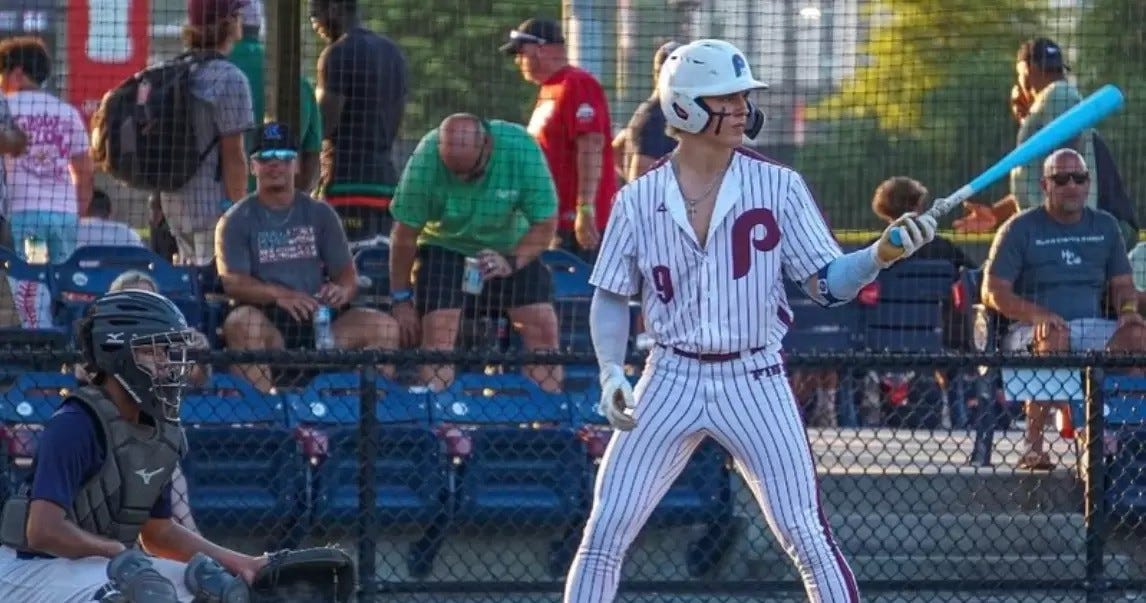
The 2026 MLB Draft kicks off today in Philadelphia — and for the Mariners, the draft has become the bread and butter of their organization. Seattle holds picks 24, 65, and 101 (they hold more, but those are the three we are discussing here). Gilbert, Kirby, Woo, Hancock, Miller — every one of them came up through this process. It is confirmation for this scouting department and front office that their process is working.
So what’s the plan this year?
Seattle made the playoffs in 2025, which means no lottery participation and a slot at #24 overall — their latest first-round pick in years. More painfully, they surrendered their Competitive Balance Round B pick (#68) to the Cardinals as part of the Brendan Donovan trade, leaving them with a $8,218,200 bonus pool — the 7th-lowest in baseball and less than half of last year’s $17,074,400. That’s not pocket change, but it is a straitjacket compared to what they had to work with when they landed Kade Anderson third overall in 2025.
The slot values for their three Day 1 picks break down like this: #24 = $3,818,700, #65 = $1,382,600, #101 = $778,200 — totaling roughly $5.98M of their pool on picks made before Sunday even starts. That means the math almost writes the strategy for them. VP of amateur scouting Scott Hunter confirmed the Mariners are scanning a board of about 14 realistic options at #24 — far wider than normal — and national reporters have tied Seattle to an underslot college arm at pick 24, freeing up money to go overslot on prep players in the later rounds.
That’s the blueprint: sign a college pitcher below slot at #24, then use the savings to land a high-ceiling prep bat in round two who’d normally require more money than the slot dictates. It’s the same framework that got them Ryan Sloan in 2024. The standard is set. Let’s talk about who they might add to it tonight.
If you find this content enjoyable, you’re in the right place. ptpmariners.com is a Mariners-first site built for fans who actually care — analytics, original writing, and takes that go deeper than the box score. Bookmark it. Tell a Mariners fan. This is the kind of day it was made for. Check out the live game analytics, trade builder or news tab!
Round 1 — Pick #24 | College Arm
Option A: Tegan Kuhns, RHP, Tennessee (The Safe Floor Pick)
The most mock-consistent name linked to Seattle at #24. MLB Pipeline’s final mock has him landing here, and SI specifically called the fit “almost too on-brand” for a Mariners pitching lab. Kuhns is a 6’3”, 190-lb sophomore righty with a mid-90s fastball averaging 94 mph and touching 98, a plus curveball with 3,000+ RPM spin, and a developing slider. MLB Pipeline grades his fastball and curveball both at 60. He was a consensus top-60 recruit out of high school who returned to school and his stuff has only climbed. The concern is a thin secondary arsenal — his slider and changeup are still works in progress — but the raw arm is everything the Mariners look for.
Option B: Ben Blair, RHP, Liberty (The Funky Underslot Value Play)
ESPN’s final mock has Blair going directly to Seattle, which would support the underslot strategy that saves pool money for prep players later. Blair is a 6’3”, 205-lb junior with a bowling-ball sinker sitting low-90s and touching 97-98, a mid-80s sweeper, cutter, and slider — as many as 5 pitches from a low three-quarters arm slot that creates a nightmare at-bat. He posted a 2.94 ERA with 86 K’s and just 9 walks in 67.1 IP as a junior — elite command out of a funky delivery. The Mariners have historically loved pitchers with unorthodox arm actions (Bryan Woo’s unusual mechanics, Jurrangelo Cjintje’s delivery), and Blair’s profile fits the pitching lab to a T. The risk: will all teams love the arm action?
Option C: Logan Reddemann, RHP, UCLA (The High-Upside Boom/Bust)
Baseball America’s mock had Reddemann going to Seattle and he was tied to the Mariners explicitly in Pipeline’s reports. A 6’2” UCLA righty, Reddemann tied the school’s single-game strikeout record this spring and vaulted from unranked to a consensus top-30 pick. He operates with a deceptive, abbreviated arm stroke from three-quarters, a fastball with ride and run in the low-to-mid 90s, and solid secondary pitches. He did miss roughly six weeks late in the season with arm fatigue, which knocked his stock down from potential top-10 territory — but the stuff, when healthy, is as good as anyone in the class. High upside, higher risk.
My pick: Logan Reddemann
Round 2 — Pick #65 | Prep Player
Option A: Martin Shelar, OF, Marist HS (GA) (The Power Bat Fits the Dipoto Mold)
The top name linked to Seattle at #65 across multiple Mariners-specific mock sources. Shelar is a 6’2”, 200-lb right-handed outfielder committed to Mississippi State with elite raw power — he hit the third-hardest ball by any player on Day 1 of the Combine at 115.5 mph, and smashed a 440-ft homer. His bat-to-ball skills are excellent, featuring above-average contact rates despite an aggressive swing, plus a tick above-average run tool and a strong arm that fits right field. He’s a physical freak for a prep bat, and Seattle is thin in OF prospects.
Option B: James Tronstein, SS/CF, Harvard-Westlake HS (CA) (The Premium Athlete)
A Vanderbilt commit from Harvard-Westlake who popped at the Combine with 111 mph exit velos and an explosive right-handed swing. Scout consensus puts him more comfortably in center than short going forward, and the power/speed blend is legitimate. His setup at the plate is unconventional but the results haven’t lied. A prep bat who may be available at #65 given signability, and the Mariners have shown a history of targeting premium athletes they believe in.
Option C: Blake Bowen, OF, JSerra HS (CA) (The Raw Power Play)
Bowen had one of the top Combine performances by any prep bat, topping out at 113.8 mph exit velocity with multiple 425-440 ft blasts and a well-above-average arm touching mid-90s from the outfield. He’s projected as a likely second-round value — the Combine performance likely secured that landing spot. A right-handed power bat with the frame and arm tools to project in right field, and a player who falls in the “quantity of tools” category the Mariners have increasingly targeted in the second round. Rumblings are that he had a poor spring.
My pick: Martin Shelar
Round 3 — Pick #101 | College Bat
Option A: Jake Brown, OF/RF, LSU (The SEC Bat-First Outfielder)
Brown has been mocked specifically to Seattle in multiple sources and was explicitly named in ESPN’s final mock. He’s a 6’2”, 205-lb left-handed hitter who came to LSU as a pitching prospect (drafted in the 16th round as a prep arm), converted to outfield, and hit .320 with solid power across two SEC seasons. He’s known for elite bat-to-ball skills, an all-fields approach, solid plus speed, and an above-average arm that plays in right. LSU’s College World Series pedigree adds another layer. The left-handed contact-first bat would complement what the Mariners have been building.
Option B: Caden Bogenpohl, OF, Missouri State (The Pound-for-Pound Power Leader)
If Bogenpohl falls to #101, it’s a massive steal. A 6’6”, 245-lb left-handed masher who broke Ryan Howard’s Missouri State freshman home run record with 20 in 2024. At the Combine, he posted a Combine-leading 119.4 mph exit velocity — the hardest-hit ball of the entire event, with 5 of the top-10 hardest hits on Day 1 (whoa). The hit tool is the question mark given his long swing and some swing-and-miss tendencies, but the plus-plus raw power is legit and he’s an athletic enough defender to cover center. A potential Day 1 name who could slip, making him a value if he reaches the third round.
Option C: Sawyer Strosnider, OF, TCU (The Tooled-Up Sophomore)
A Big 12 freshman of the year who hit .350/.420/.650 with 11 homers, 10 triples, and 10 steals as a freshman. Strosnider is 6’2”, 200-lb, and left-handed with plus speed, a plus arm, and plus raw power — a legitimate five-tool candidate. His 2026 season has been a step back, which is why he’s sliding from a potential top-15 pick to this range. Baseball America ranks him 14th overall; Pipeline has him 22nd — meaning if the Mariners are getting him at #101, that would be an absolute value pick. The Mariners development system is exactly the kind of place where a toolsy, swing-decision-challenged outfielder could unlock his ceiling.
My pick: Jake Brown
I will likely go 0-for-3 here. But, all in good fun.
Enjoy Baseball. Enjoy the draft.